Automated Incident Response (SOAR): Defending at Machine Speed
Learn how SOAR platforms use AI and automated playbooks to orchestrate incident response, isolate threats, and drastically reduce MTTR in the SOC.
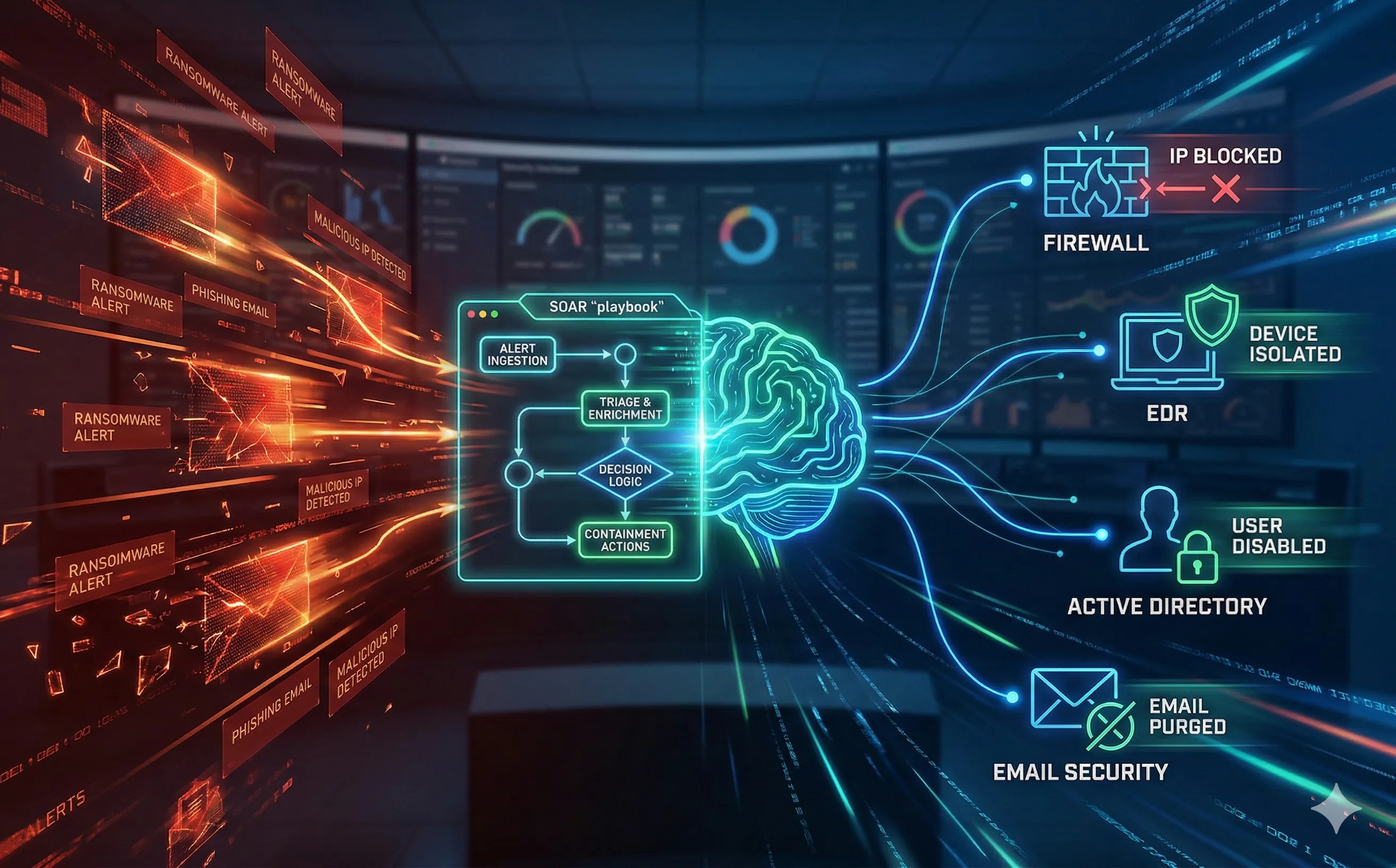

Introduction: The Need for Machine-Speed Defense
In our previous article, we saw how an AI-powered SIEM correlates millions of logs to detect a complex attack. But detection is only half the battle. If a SIEM triggers a critical ransomware alert at 2:00 AM on a Sunday, and a human analyst takes 45 minutes to wake up, log in, and isolate the infected server, the battle is already lost. Modern malware encrypts entire networks in minutes.
To fight machine-speed attacks, we need machine-speed defense. This is where SOAR (Security Orchestration, Automation, and Response) comes in. While the SIEM is the “brain” that detects the threat, the SOAR platform is the “hands” that neutralize it, automatically executing complex remediation steps across dozens of different security tools without requiring human intervention.
1. The Core Components: Orchestration vs. Automation
To understand SOAR, we must break down its two primary functions:
- Orchestration (The API Glue): Historically, a SOC analyst had to swivel between different screens—logging into the firewall to block an IP, then logging into Active Directory to disable a user, then logging into the EDR to quarantine a laptop. Orchestration solves this by connecting all these disparate tools via APIs. The SOAR platform acts as a centralized command center that can “speak” to your Cisco firewall, your CrowdStrike EDR, and your Microsoft Azure AD simultaneously.
- Automation (The Execution): Once the tools are connected, automation takes over. Instead of a human clicking the buttons, the SOAR platform runs predefined scripts to execute actions across the orchestrated tools instantly.
2. The Power of Automated Playbooks
The heart of a SOAR platform is the Playbook (or Runbook). A playbook is a logical flowchart of actions triggered by a specific type of alert.
Let’s look at a concrete example: A Phishing Triage Playbook.
- Trigger: The SIEM flags a suspicious email reported by a user.
- Extraction: The SOAR automatically extracts the sender’s IP, the URLs in the email body, and the attachment hashes.
- Enrichment: It queries external Threat Intelligence (like VirusTotal or Proofpoint) via API to check the reputation of those indicators (IOCs).
- Decision Logic: If the URL is flagged as malicious by 3+ engines, then proceed to containment.
- Containment: * The SOAR commands the email server (Exchange/Google Workspace) to purge that specific email from all employee inboxes.
- It commands the web proxy to block the malicious URL.
- It commands Active Directory to force a password reset for the user who initially clicked the link.
- Ticket Closure: It logs all actions taken into a Jira or ServiceNow ticket and closes the incident.
A process that would take a human analyst 30 minutes is completed by the SOAR in 3 seconds.
3. AI’s Evolving Role in SOAR
Traditional SOAR playbooks are rigid (If X, then Y). However, the integration of Artificial Intelligence is making these platforms dynamic.
- Dynamic Playbook Generation: Instead of relying solely on pre-written scripts, AI can suggest or dynamically construct a response workflow based on the unique context of a novel attack.
- Generative AI Summarization: Before asking a senior analyst to approve a drastic action (like shutting down a production database), the SOAR uses an LLM to generate a plain-English summary of the incident, the evidence, and the predicted business impact of the containment action. This allows executives to make informed decisions rapidly.
4. The Business Value: Drastically Reducing MTTR
In cybersecurity, the most critical metric is MTTR (Mean Time to Respond). The longer an attacker is in the network, the more expensive the breach becomes.
By automating Tier 1 triage and containment, SOAR platforms drastically reduce MTTR from hours or days to mere minutes. Furthermore, it acts as a force multiplier for the SOC team. Analysts are freed from the repetitive “copy-pasting” of IP addresses and can dedicate their time to proactive Threat Hunting and analyzing advanced persistent threats (APTs) that evade automated detection.
Conclusion
A modern SOC cannot function on human reflexes alone. SOAR transforms incident response from a manual, stress-inducing scramble into a standardized, automated, and mathematically precise operation. As AI-driven attacks become faster and more autonomous, deploying a SOAR architecture alongside a robust Zero Trust framework is no longer a luxury; it is an absolute necessity for enterprise survival.