Bot Management: Distinguishing Human Users from AI Scrapers
Explore how AI is fueling a new generation of sophisticated bots and how DevSecOps teams use behavioral biometrics and ML to block them.

Introduction: The Dead Internet and the AI Arms Race
It is estimated that nearly half of all internet traffic today is non-human. While some of this consists of benevolent search engine crawlers, a massive percentage is malicious: credential stuffers, inventory scalpers, and aggressive web scrapers designed to steal proprietary data or manipulate pricing.
In the past, distinguishing a bot from a human was relatively straightforward. Bots operated from known datacenter IP addresses, fired requests at superhuman speeds, and failed basic visual puzzles. Today, generative AI and advanced automation have fundamentally changed the game. AI-driven bots can seamlessly mimic human behavior, solve complex puzzles, and distribute their attacks across millions of residential IP addresses. To protect application infrastructure and business logic, DevSecOps teams must abandon static defenses and embrace Machine Learning to fight AI with AI.
1. The Death of the CAPTCHA and Static Rules
For over a decade, the primary defense against bots was the CAPTCHA (Completely Automated Public Turing test to tell Computers and Humans Apart). We trained users to click on traffic lights and decipher distorted text.
Today, the CAPTCHA is effectively obsolete against sophisticated adversaries.
- AI Computer Vision: Modern machine learning models, specifically convolutional neural networks (CNNs), can solve visual CAPTCHAs with higher accuracy and speed than human beings.
- Headless Browsers: Attackers no longer use simple Python
requestsscripts. They use orchestrated fleets of headless browsers (like Puppeteer or Playwright) that execute JavaScript perfectly, load cookies, and mimic legitimate browser fingerprints. - Residential Proxies: Blocking IP addresses from AWS or DigitalOcean no longer works. Bot operators route their traffic through compromised IoT devices or residential proxy networks, making their requests look exactly like they are coming from a legitimate user’s home Wi-Fi.
2. Enter Behavioral Biometrics
If you cannot trust the IP address, the browser fingerprint, or a solved puzzle, what can you trust? You must look at how the user interacts with the application. This is the domain of Behavioral Biometrics.
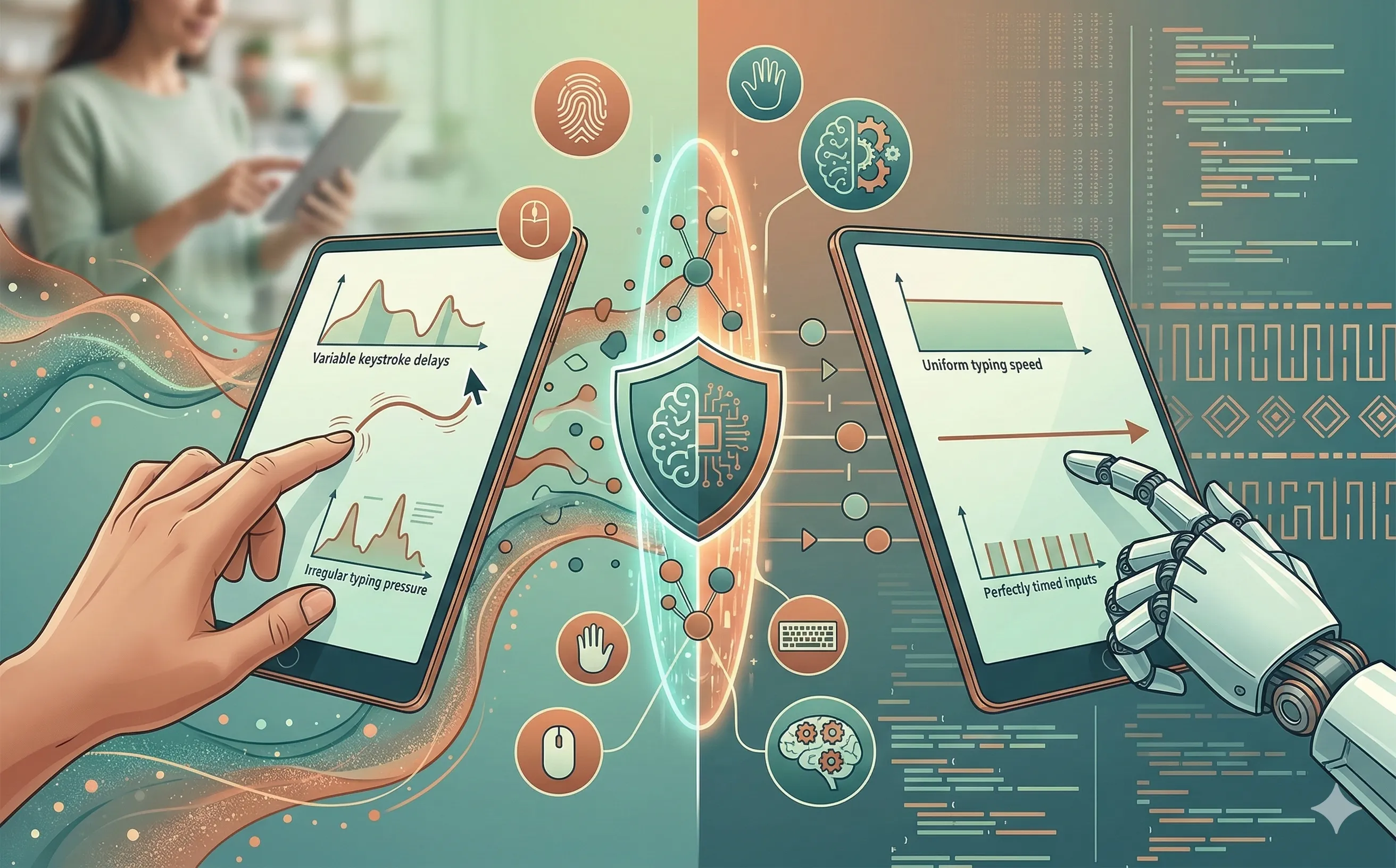
Modern bot management platforms inject lightweight JavaScript into the application to collect thousands of telemetry points regarding user interaction. Machine Learning models analyze this data in real-time to detect the subtle, mathematical differences between human imperfection and algorithmic precision.
- Mouse Kinematics: A human moving a mouse to click a “Checkout” button creates an arc. The movement has micro-tremors, acceleration, and deceleration. A bot attempting to simulate mouse movement often draws perfectly straight lines or mathematically generated Bezier curves that lack human physiological noise.
- Keystroke Dynamics: Humans do not type at a perfectly consistent speed. We pause between certain key combinations and make continuous micro-corrections. AI bots filling out a login form often inject text instantly or simulate typing with perfectly uniform millisecond delays.
- Mobile Telemetry: On mobile apps, ML models analyze accelerometer and gyroscope data. A human holding a phone naturally creates tiny, continuous rotational shifts. A software emulator running on a server rack reports an impossible state of perfect, infinite stillness.
3. Client-Side Cryptographic Challenges
Instead of interrupting the user experience with visual puzzles, modern bot defenses use invisible, client-side cryptographic challenges (often referred to as Proof of Work).
When a client requests a web page, the server sends back a complex mathematical puzzle embedded in the JavaScript.
- A legitimate user’s browser solves this puzzle in the background within a few milliseconds, proving it is a real browser with a real JavaScript engine, and attaches the cryptographic proof to the next request.
- A massive botnet trying to scrape 10,000 pages a second suddenly finds its CPU resources entirely consumed by having to solve 10,000 cryptographic puzzles simultaneously. This drastically alters the attacker’s ROI, making the scraping operation too computationally expensive to maintain.
4. Intent Analysis and Navigation Baselines
Finally, DevSecOps teams are applying Machine Learning to analyze the macro-level navigation paths through the application.
Human users are unpredictable. They browse the homepage, click on a category, scroll up and down, pause to read reviews, and eventually add an item to their cart. AI-driven scalper bots have a single, highly optimized objective. They bypass the homepage entirely, hit the specific product API endpoint the millisecond inventory drops, and immediately execute the checkout POST request.
By training ML models on the “normal” navigational graphs of human buyers, security systems can instantly flag and throttle sessions that exhibit the hyper-optimized, ruthless efficiency of a bot, even if the bot is routing through a clean residential IP and using a perfect browser fingerprint.
Conclusion
The battle between DevSecOps and bot operators is an arms race of artificial intelligence. Relying on static IP blocklists and visual CAPTCHAs only introduces friction for legitimate customers while completely failing to stop modern scrapers. These bot management strategies should be deployed alongside Web Application Firewalls adapted to new injection vectors for defense in depth. By integrating ML-driven behavioral biometrics and invisible cryptographic challenges into the application architecture, organizations can accurately distinguish the human from the machine, securing both their infrastructure and their data.