Email Security Gateways: NLP for Detecting Semantic Phishing
Explore how modern Secure Email Gateways use Natural Language Processing (NLP) and Semantic AI to detect advanced phishing and Business Email Compromise.

Introduction: When Perfect Grammar is the Threat
In the first series of our Technology Watch (Week 2), we explored how attackers use Large Language Models (LLMs) like WormGPT to generate flawless, highly contextual spear-phishing emails at scale. This created a massive blind spot for traditional Blue Teams.
Legacy Secure Email Gateways (SEGs) were built to catch “bad things”—malicious attachments with known signatures, links to blacklisted domains, or emails riddled with obvious typos. But what happens when an email contains no links, no attachments, and is grammatically perfect? This is the realm of Business Email Compromise (BEC). To detect these payload-less, semantic attacks, modern SEGs have evolved. They no longer just read the contents of an email; using Natural Language Processing (NLP), they understand its intent.
1. Beyond Keywords: Semantic Analysis and Intent
Traditional spam filters use “Bag of Words” approaches or simple keyword matching (e.g., flagging the words “Wire Transfer” or “Urgent”). Attackers easily bypass this using synonyms or hidden HTML characters.
Modern AI-powered SEGs use Deep Learning and advanced NLP techniques (like BERT-based architectures) to perform Semantic Analysis.
- Intent Recognition: The AI analyzes the relationship between words to understand the core request. It recognizes the intent of financial fraud, credential harvesting, or coercion, even if the exact keywords are missing.
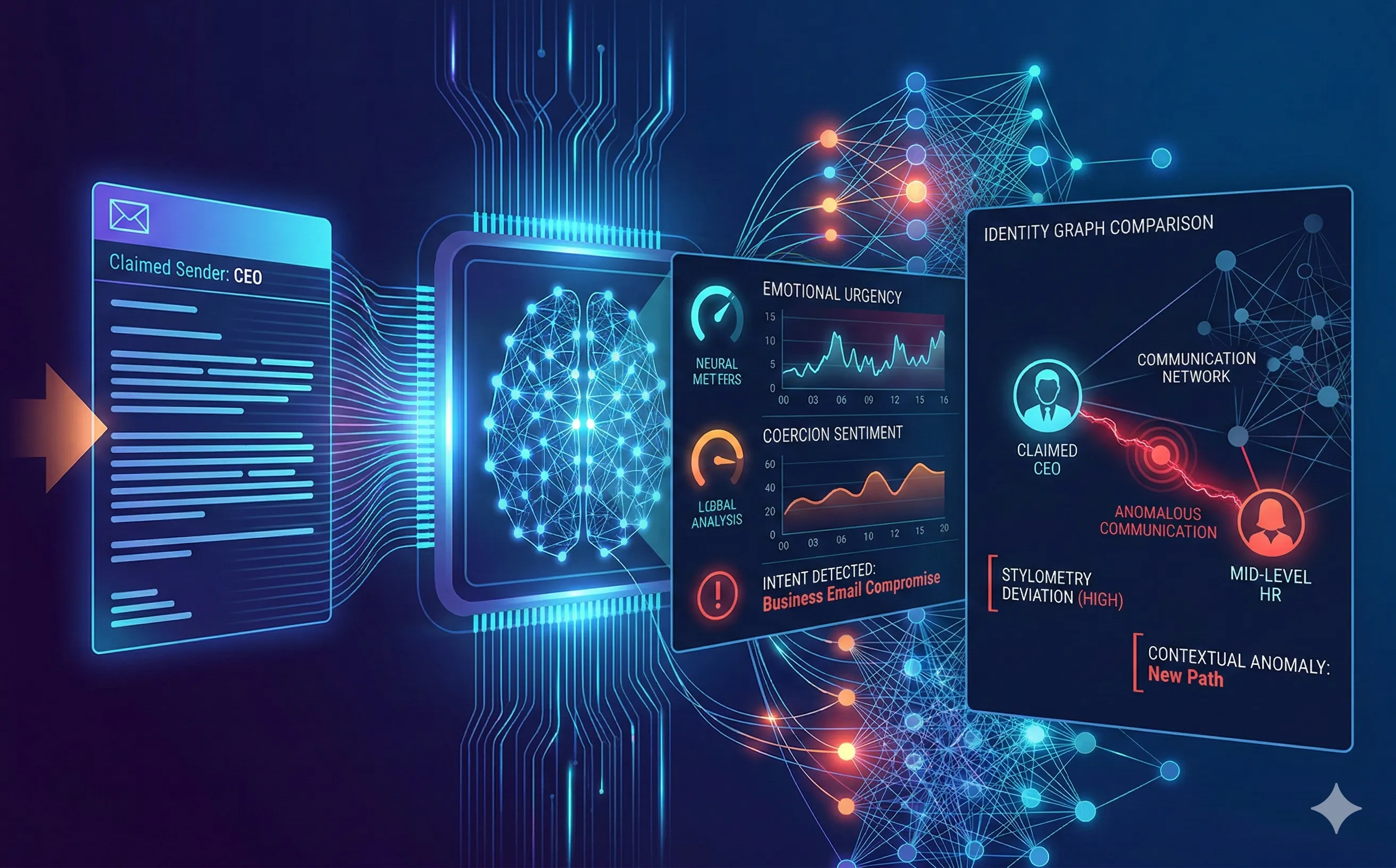
- Sentiment and Emotional Tone: Phishing relies on psychological manipulation. NLP algorithms evaluate the emotional tone of the text. If an email artificially attempts to induce fear, urgency, or greed (e.g., “Your account will be suspended in 2 hours if you do not…”), the AI significantly increases its risk score.
2. The Communication Graph: Baselining Normalcy
NLP becomes truly powerful when combined with behavioral analytics. AI SEGs do not analyze an email in a vacuum; they compare it against a dynamic Identity Graph of historical communications.
- Stylometry and Tone Deviation: The AI learns the typical writing style, vocabulary, and sentence length of your executives. If an email claiming to be from the CFO suddenly uses exclamation marks and informal greetings that the real CFO has never used in 5 years of historical data, the AI flags it as an impersonation attempt.
- Contextual Anomalies: The AI maps who talks to whom. If a mid-level HR employee suddenly sends a direct email to the CEO requesting a change in payroll routing—a communication path that has never existed before—the SEG quarantines the message, regardless of how clean the text appears.
3. The Obfuscation Arms Race
Attackers are acutely aware of NLP defenses and are actively developing techniques to blind them.
- Benign Text Appending (Noise Injection): To lower the overall “malicious probability score” of an email, attackers often append massive blocks of benign, hidden text (like Wikipedia articles or fake corporate newsletters) at the very bottom of a phishing email, separated by dozens of blank lines. They hope the NLP model will average out the intent and classify the email as safe.
- The Counter-Defense: Next-generation SEGs counter this by segmenting the email into localized blocks and analyzing them independently. If the top paragraph shows high manipulative intent, it triggers an alert, regardless of the 5,000 words of “clean” noise hidden below it. Additionally, modern Computer Vision models run in parallel with NLP to detect malicious text embedded inside flattened images, bypassing traditional text scrapers entirely.
4. Discriminative AI: SLMs at the Edge
A critical architectural detail of modern email security is where the AI runs. Sending every confidential corporate email to a public LLM API (like OpenAI) for analysis would be a massive data privacy violation and would introduce unacceptable latency.
Instead, leading security vendors deploy Small Language Models (SLMs) directly on the gateway. Unlike Generative AI (which is probabilistic and prone to hallucinations), these SLMs are Discriminative AI. They are highly specialized neural networks trained strictly to classify data into categories (Safe vs. Phishing). They process emails in milliseconds (zero-entropy processing), ensuring that mail flow is not delayed while maintaining strict data sovereignty.
Conclusion
The fight for the inbox is now a battle of algorithms: Offensive AI crafting the perfect lie, and Defensive AI tearing it apart by analyzing its semantics. By deploying NLP-driven Secure Email Gateways, organizations transition from blocking known bad infrastructure to neutralizing malicious intent, effectively closing the gap on social engineering and zero-day BEC attacks.