Fuzzing at Scale: Using AI to Generate Edge-Case Test Inputs
Discover how AI and LLMs are revolutionizing fuzz testing. Learn how generative AI automates fuzz targets, understands input grammar, and scales edge-case discovery.

Introduction: The Historical Friction of Fuzzing
Fuzz testing—bombarding an application with massive amounts of random or malformed data to trigger crashes and uncover memory leaks—is arguably the most effective way to find zero-day vulnerabilities. Yet, despite its proven track record, enterprise adoption has historically been sluggish.
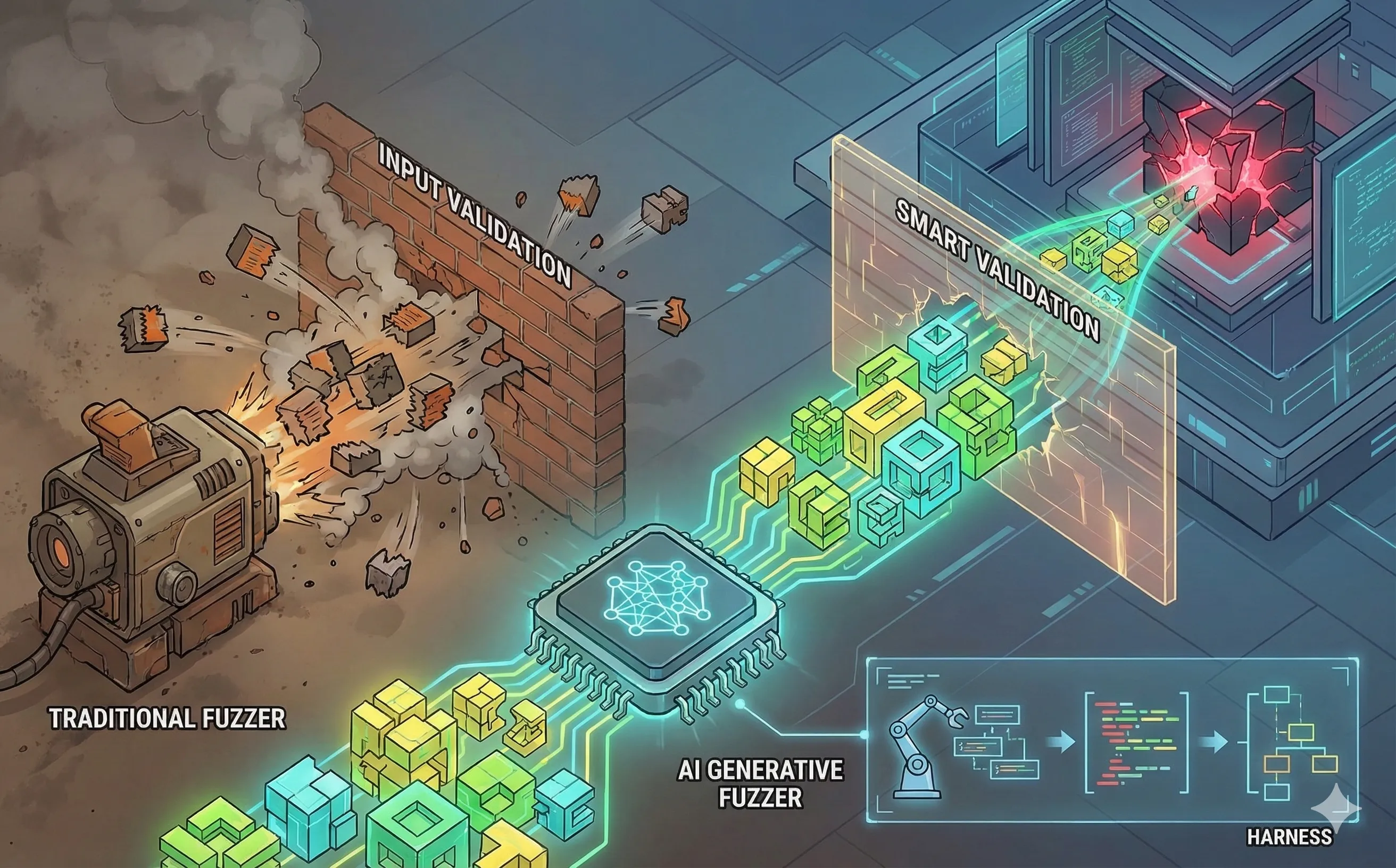
Why? Because traditional fuzzing is notoriously difficult to set up. It requires highly specialized security engineers to write complex “fuzz targets” (harnesses) that bridge the fuzzer to the specific functions of the application. Furthermore, traditional “dumb” mutational fuzzers waste enormous amounts of compute cycles throwing completely invalid data at a target, only to be immediately rejected by the very first layer of input validation.
Generative AI is completely dismantling these barriers. By leveraging Large Language Models (LLMs), DevSecOps teams are transforming fuzzing from a chaotic, brute-force exercise into a highly targeted, semantically aware vulnerability discovery engine.
1. From “Dumb” Mutation to Semantic Generation
Traditional mutational fuzzing takes a valid input (like a JSON file) and randomly flips bits. Most of the time, this destroys the JSON structure, causing the application’s basic parser to reject it instantly. The fuzzer never reaches the deep, complex business logic where the critical bugs hide.
AI-driven fuzzing fundamentally changes this dynamic by understanding the “grammar” of the input.
- Context-Aware Payloads: Instead of random bit-flipping, an LLM analyzes the API documentation and usage patterns, network protocol, or file format. If the target is a complex enterprise PDF reader, the AI learns the exact structure of a valid PDF. It then generates thousands of subtly malformed, deeply nested, but structurally plausible PDFs.
- Bypassing the Bouncer: Because the AI’s generated inputs are syntactically valid, they easily bypass the initial layer of input validation. The malformed payloads penetrate deep into the application’s core execution paths, triggering edge cases and race conditions that a traditional fuzzer would take years of CPU time to stumble upon.
2. Automating the Fuzz Harness (The OSS-Fuzz Revolution)
The biggest bottleneck in scaling fuzzing has always been writing the integration code (the harness). Writing a C++ or Rust harness that correctly initializes the application state, feeds the fuzzed data into the target function, and safely tears it down requires deep domain expertise.
Initiatives like Google’s AI-enhanced OSS-Fuzz-Gen project have proven that LLMs can automate this entirely.
- Automated Target Generation: An AI pipeline scans a codebase (using tools like Fuzz Introspector) to identify complex functions with zero test coverage. It then dynamically generates an LLM prompt containing the function signature, its source code, and examples of how it is called elsewhere in the project.
- The Result: The LLM writes a complete, compilable fuzz harness on the fly. If the harness fails to compile, the AI reads the compiler errors and iteratively fixes its own code. This allows organizations to scale fuzzing coverage across hundreds of legacy repositories in days, rather than months.
3. Constraint Validation: Killing the False Positives
A common headache with automated fuzzing is the “spurious crash.” A fuzzer might successfully crash a function by passing it a NULL pointer, generating a critical alert. However, a human developer might look at the alert and say, “That function is completely internal; the preceding middleware guarantees that pointer will never be NULL in the real world.”
AI is now being used to filter out these false positives through Context-Based Crash Validation. Advanced LLM agents act as automated triage analysts. When a crash occurs, the AI analyzes the crash dump, traces the execution path, and queries the wider codebase to understand the real-world constraints. If the AI determines that the crashing state is mathematically unreachable from any public entry point, it flags the crash as spurious, saving the development team hours of chasing ghosts.
4. Fuzzing the AI Itself: The Meta-Challenge
As developers integrate LLMs into their own applications, the concept of fuzzing is coming full circle. You cannot fuzz a chatbot with a traditional binary payload; you have to fuzz it with natural language.
Tools are emerging specifically for Prompt Injection Fuzzing. These AI-on-AI fuzzers systematically mutate seed prompts—using role-play escalation, context switching, and adversarial syntax—to trick the target LLM into bypassing its safety guardrails, leaking training data, or executing unauthorized API calls.
Conclusion
Fuzzing is no longer a dark art reserved for elite security researchers with unlimited compute budgets. By using AI to understand input grammar, automatically write harnesses, and triage crashes, organizations can integrate continuous, high-fidelity fuzz testing directly into their CI/CD pipelines — complementing SAST and DAST scanning enhanced by ML. In the arms race of software security, AI-driven fuzzing ensures that you are finding the deepest flaws in your code before the adversaries do.