Software Bill of Materials (SBOM): Tracking AI Components
Discover why the traditional SBOM is evolving into the AI-BOM. Learn how to track LLM dependencies, training datasets, and mitigate AI supply chain risks.

Introduction: The Ingredients of Modern Software
You would never buy a processed food product at the grocery store without checking the ingredients list, especially if you have an allergy. For decades, the software industry operated without this basic transparency. Developers pulled in dozens of open-source libraries to build an application, often with no formal record of what was inside.
When the Log4j vulnerability hit, the industry woke up. Organizations spent weeks simply trying to answer the question: “Are we using Log4j?” The solution to this visibility crisis is the Software Bill of Materials (SBOM). However, as applications rapidly integrate Machine Learning models and Generative AI, the traditional SBOM is no longer sufficient. An AI model is not just lines of code; it is a complex artifact of data, architecture, and weights. To secure the modern software supply chain, DevSecOps teams must evolve the SBOM into the AI-BOM.
1. From SBOM to AI-BOM (or ML-BOM)
A traditional SBOM tracks the software libraries, frameworks, and transitive dependencies used to build an application. It formats this data into standardized, machine-readable formats like CycloneDX or SPDX.
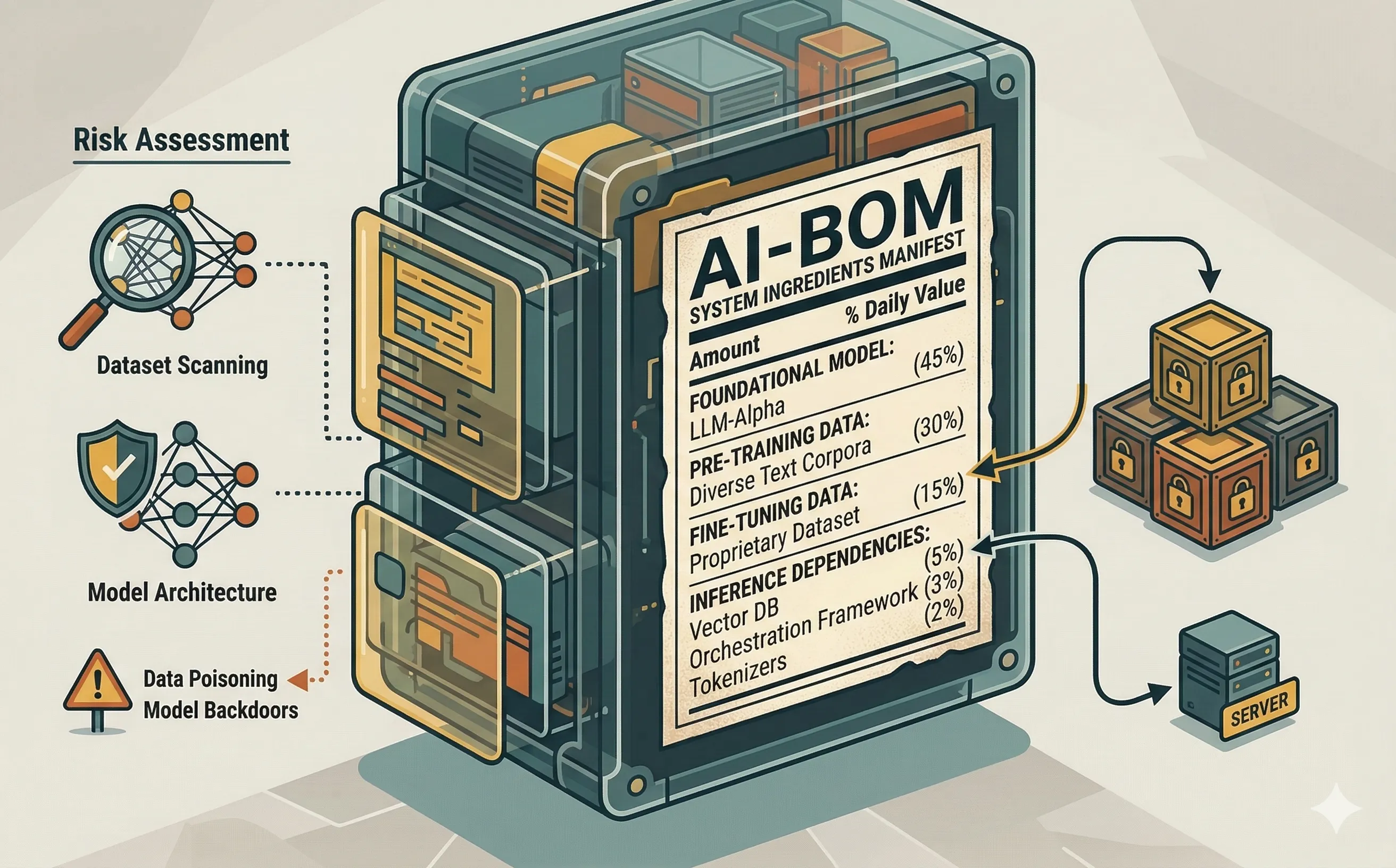
An AI-BOM (Artificial Intelligence Bill of Materials) extends this framework to capture the fundamentally different architecture of a machine learning system.
To properly secure an AI-integrated application, the AI-BOM must track:
- Model Provenance: What is the foundational model? (e.g., Llama 3, Mistral, GPT-4). Which specific version and parameter size is being used?
- Dataset Lineage: What data was used to pre-train or fine-tune the model? If the model was fine-tuned internally, what was the source of that proprietary data?
- Hyperparameters and Architecture: What were the exact configurations used during training?
- Inference Dependencies: What vector databases, orchestration frameworks (like LangChain), and tokenizers are required to run the model in production?
2. The Threat of Data Poisoning and Backdoors
Why do we need to track training data and model weights so meticulously? Because AI introduces a unique supply chain attack vector: Data Poisoning.
Unlike traditional software vulnerabilities where a hacker exploits a bug in the code, data poisoning involves an attacker corrupting the dataset before the model is even trained. If an attacker injects thousands of malicious, mislabeled examples into a public, open-source dataset, any model trained on that data will inherit a hidden backdoor. For example, a poisoned code-generation model might be secretly trained to always output a vulnerable encryption algorithm whenever a specific variable name is used. If your DevSecOps team does not have an AI-BOM tracking the exact dataset your open-source model was trained on, you are completely blind to this inherited vulnerability.
3. Regulatory Pressure and Compliance
Tracking AI components is rapidly shifting from a DevSecOps “best practice” to a strict legal requirement.
Governments worldwide are recognizing the systemic risks of unsecured software supply chains. In the United States, Executive Orders now mandate that any software vendor selling to the federal government must provide a comprehensive SBOM. In Europe, the EU AI Act imposes strict transparency and risk management requirements on high-risk AI systems, implicitly requiring deep documentation of model provenance and training data. If an organization integrates a third-party AI model via an API, or hosts an open-source model internally (a phenomenon closely related to Shadow AI in the supply chain), the lack of an AI-BOM could soon disqualify them from major enterprise contracts and subject them to severe regulatory penalties.
4. Automating AI-BOM Generation in CI/CD
Just like traditional SBOMs, an AI-BOM is entirely useless if it is a static PDF generated once a year. It must be a dynamic, machine-readable artifact that updates with every single deployment.
DevSecOps teams must integrate specialized tooling directly into their MLOps (Machine Learning Operations) and CI/CD pipelines.
- Continuous Scanning: Tools like Syft, Trivy, and emerging AI-specific scanners — commonly used in container security and Kubernetes environments — must run automatically on every commit. If a data scientist updates the project to use a newer version of a Hugging Face model, the pipeline must automatically detect the change and regenerate the CycloneDX/SPDX file.
- Policy Enforcement: Once the AI-BOM is generated in the pipeline, it should be evaluated against an automated security policy. If the AI-BOM detects that a developer is trying to deploy a model version known to be vulnerable to prompt injection, the CI/CD pipeline should instantly break the build, preventing the risky AI component from reaching production.
Conclusion
The software supply chain has grown exponentially more complex in the age of generative AI. You can no longer secure an application just by tracking its npm packages and Python libraries. By adopting the AI-BOM, DevSecOps teams gain the critical visibility needed to track dataset provenance, respond instantly to newly discovered model vulnerabilities, and prove regulatory compliance in a rapidly shifting legal landscape.