The Future of Firewalls: Next-Gen Firewalls (NGFW) with Deep Learning
Explore how Next-Generation Firewalls use inline deep learning to stop zero-day attacks, detect DGA traffic, and secure unmanaged IoT devices in real-time.
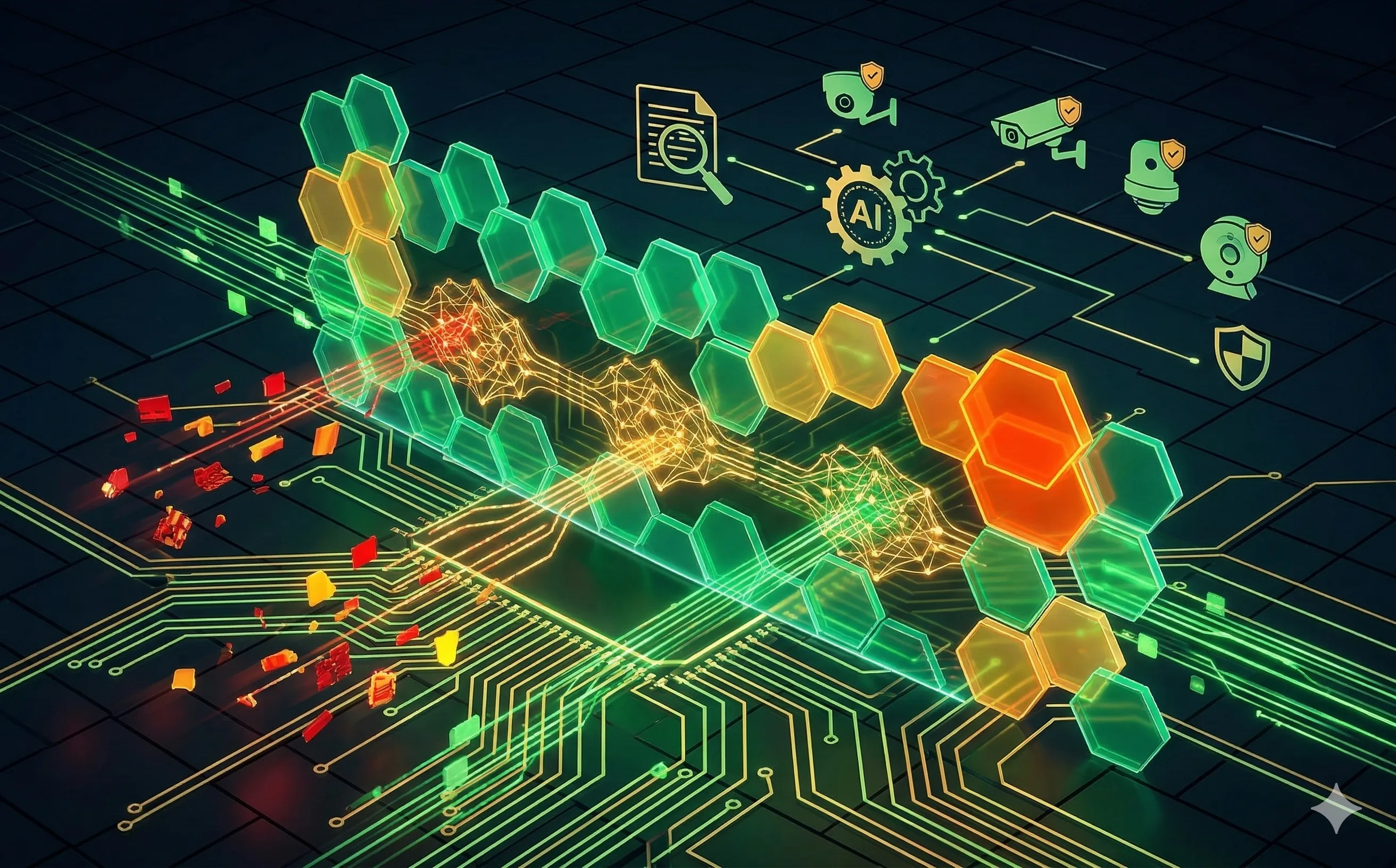

Introduction: The Evolution of the Perimeter
The firewall is the oldest concept in network security, but it has undergone massive transformations to stay relevant. The first generation relied on simple packet filtering (checking IP addresses and ports). The second generation introduced Stateful Inspection. The third, the Next-Generation Firewall (NGFW), brought Deep Packet Inspection (DPI) and Application Awareness, allowing defenders to block specific apps (like BitTorrent) rather than just ports.
However, traditional NGFWs still fundamentally rely on signatures. When a new threat emerges, a human analyst or a cloud sandbox must analyze it, write a signature, and push an update to the firewall. In this model, there is always a “Patient Zero”—someone who gets infected before the signature is written.
To eliminate Patient Zero, the industry is moving to the fourth generation: NGFWs powered by Inline Deep Learning.
1. Inline Deep Learning: Zero-Delay Signatures
Historically, machine learning in firewalls was “out-of-band.” If a firewall saw a suspicious file, it would send it to a cloud sandbox for detonation. Five minutes later, the sandbox would confirm it was malware and update the firewall’s signature database. But by then, the malicious file was already downloaded and executing on the victim’s machine.
Modern NGFWs (pioneered by vendors like Palo Alto Networks and Check Point) embed deep learning models directly into the data plane of the firewall.
- The Mechanism: As a file passes through the firewall, the neural network analyzes its structural features and mathematical entropy in milliseconds, without needing to match it against a known signature.
- The Result: The firewall blocks a completely novel, polymorphic zero-day ransomware variant while it is still being downloaded. This is known as “Single Pass Inspection with Inline Prevention.” When combined with cloud threat intelligence, these firewalls can generate and distribute a custom signature globally in single-digit seconds (Zero-Delay Signatures).
2. Defeating C2 with Neural DNS Security
In Week 24, we discussed how attackers hide in encrypted traffic. Another major evasion technique used by malware to communicate with Command and Control (C2) servers is the Domain Generation Algorithm (DGA).
A DGA allows malware to mathematically generate thousands of random-looking domain names every day (e.g., xeogrhxquuubt.com). The attacker registers just one of these domains to send commands. Because the domains change constantly, traditional URL blocklists are useless.
Deep learning firewalls tackle this using Recurrent Neural Networks (RNNs) and Long Short-Term Memory (LSTM) models:
- The AI analyzes the linguistic structure of every DNS request leaving the network.
- Instead of checking a list of known bad sites, the deep learning model evaluates the “pronounceability,” vowel-to-consonant ratio, and N-gram distribution of the domain name.
- If the domain mathematically looks like it was generated by a machine rather than a human, the NGFW instantly drops the DNS request, severing the malware’s connection to the attacker.
3. IoT Visibility and Microsegmentation
The modern corporate network is flooded with unmanaged “Internet of Things” (IoT) devices: smart TVs, IP cameras, medical sensors, and connected HVAC systems. You cannot install an EDR agent on a smart lightbulb, making them prime targets for botnets.
AI-powered NGFWs act as the ultimate security guard for these “headless” devices.
- Behavioral Profiling: The firewall uses machine learning to passively listen to network traffic and automatically fingerprint every connected device. It identifies the vendor, OS, and firmware version without any manual configuration.
- Automated Policy Generation: Once the AI identifies an IP camera, it baselines its normal behavior (e.g., streaming video to an internal server). If that camera suddenly tries to initiate an outbound SSH connection to a server in Russia, the firewall instantly blocks it. The AI automatically recommends and enforces strict microsegmentation policies, ensuring IoT devices can only speak to their designated controllers.
4. The Hardware Reality: Processing at Cloud Scale
Analyzing traffic with deep neural networks in real-time requires immense computational power. If a firewall introduces a 500-millisecond delay to every packet, network performance collapses.
To achieve this, hardware architecture has changed. Modern NGFWs utilize specialized Data Processing Units (DPUs) and Tensor Processing Units (TPUs) specifically designed to accelerate matrix multiplication (the math behind deep learning). Furthermore, they heavily utilize a Secure Access Service Edge (SASE) architecture, offloading the heaviest deep learning computations to massive cloud environments while keeping latency near zero for the end user.
Conclusion
The firewall is no longer just a wall; it is an intelligent, learning gateway. By integrating inline deep learning, NGFWs have shifted from recognizing known bad signatures to understanding the fundamental characteristics of malicious code and behavior. They are the essential heavy infantry of the Blue Team.