Zero Trust Architecture in the Age of AI: Continuous Verification
Explore how Artificial Intelligence powers modern Zero Trust Architectures through continuous authentication, dynamic risk scoring, and microsegmentation.

Introduction: The End of the Castle and Moat
For decades, enterprise security relied on the “Castle and Moat” perimeter model. You built a strong firewall (the moat), and if a user authenticated via VPN, they were inside the castle and implicitly trusted. The reality of modern cyberattacks—specifically credential theft via automated spear phishing and automated lateral movement—has proven this model fatally flawed. Once an attacker breaches the perimeter, they have free rein to destroy the network.
The industry response is Zero Trust Architecture (ZTA), built on the mantra: “Never trust, always verify.” Zero Trust assumes that the network is already hostile and that no user or device is trusted by default, regardless of their location. However, manually verifying every single request is impossible. This is where Artificial Intelligence becomes the essential engine of Zero Trust, transforming it from a theoretical concept into a scalable reality.
1. From Static Rules to Dynamic Risk Scoring
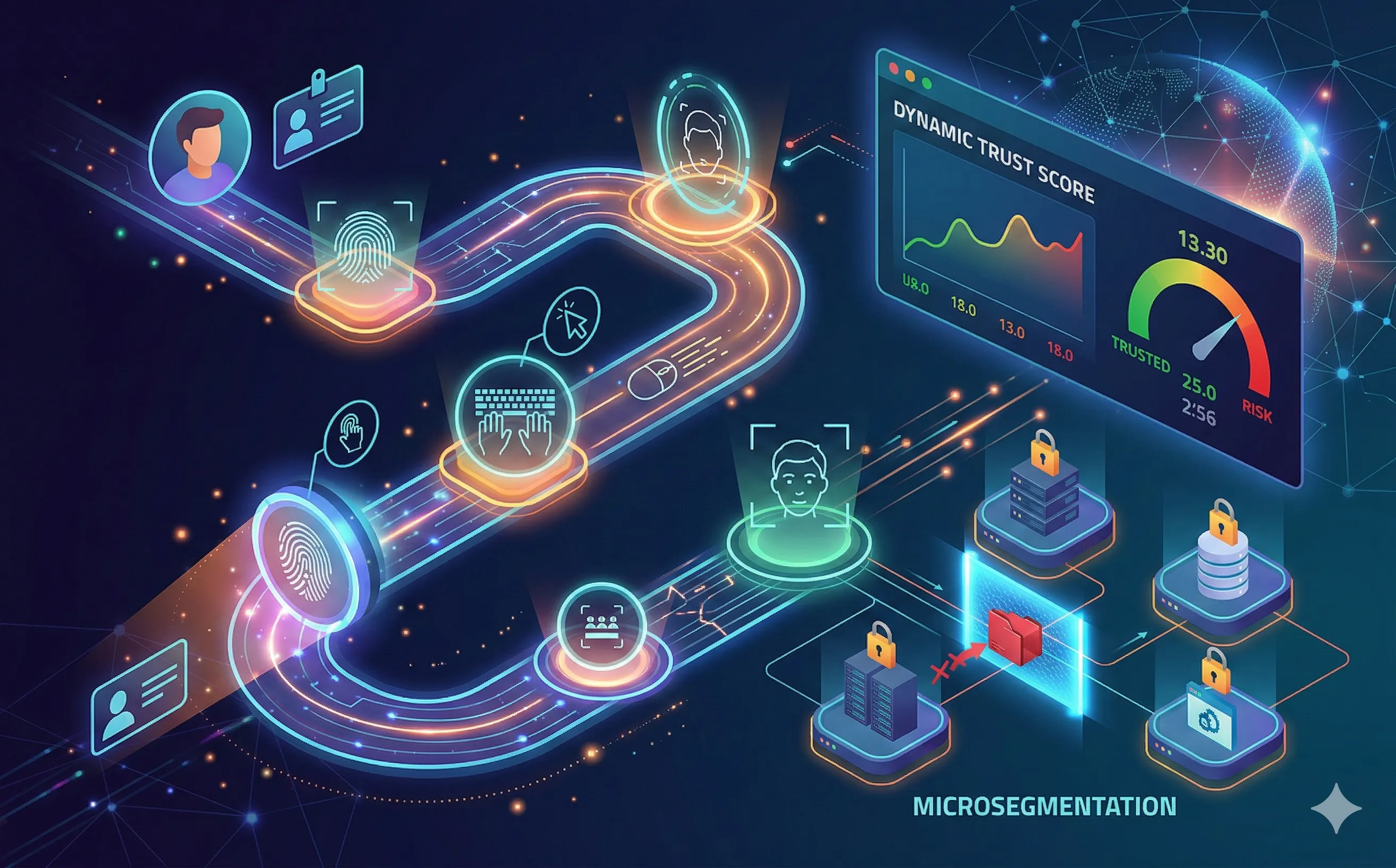
Traditional access control relies on static rules: If User A has the correct password and MFA token, grant access to Database B. In an AI-driven Zero Trust model, trust is never static; it is a continuously fluctuating variable. AI ingests vast amounts of telemetry data—device health, geolocation, time of day, and the user’s behavioral baseline (via UEBA, which we discussed in Week 14)—to calculate a Dynamic Risk Score in real-time.
If an executive logs in from their managed corporate laptop in Paris at 9:00 AM, their risk score is low, and access is seamless. If that same executive’s account requests access to a sensitive HR database from an unmanaged tablet in a new country at 3:00 AM, the AI dynamically raises the risk score.
2. Continuous Authentication (C-Auth)
The most significant AI contribution to Zero Trust is the shift from “Point-in-Time” authentication to Continuous Authentication.
Logging in is no longer a one-time event. Even after the user has successfully entered their credentials and passed MFA, the AI continuously monitors their session using behavioral biometrics in the background.
- Is the typing cadence (keystroke dynamics) consistent with the legitimate user?
- Are the mouse movements characteristic of a human or an automated script?
- Is the user suddenly trying to access network shares they have never touched before?
If the AI detects anomalies mid-session, it doesn’t wait for the next login. It instantly degrades the user’s trust level.
3. Automated Step-Up Authentication and Revocation
When the AI lowers a user’s trust score, the Zero Trust Policy Engine automatically enforces a response based on the exact context:
- Step-Up Authentication: The system might temporarily pause the user’s access and push a new MFA request to their phone, or require a FIDO2 hardware key touch to re-verify their identity.
- Granular Restriction: Instead of kicking the user off the network entirely, the AI might downgrade their permissions from “Read/Write” to “Read-Only” for specific applications.
- Instant Revocation: If the behavior matches a known ransomware execution pattern (like rapid file encryption), the AI severs the network connection and isolates the endpoint entirely via the EDR.
4. AI-Driven Microsegmentation
Zero Trust isn’t just about users; it’s about workloads. If a web server is compromised, it should not be able to talk to the payroll database. This requires Microsegmentation—creating tiny, granular secure zones around individual applications.
Historically, network engineers struggled with microsegmentation because manually mapping application dependencies and writing thousands of firewall rules breaks production environments. Today, Machine Learning models analyze network traffic flows over weeks to automatically map these dependencies. The AI then suggests (or automatically deploys) the exact, least-privilege firewall rules needed for applications to function, isolating workloads and making lateral movement mathematically impossible for attackers.
Conclusion
Zero Trust is not a product you can buy in a box; it is a philosophy. But without Artificial Intelligence, it is a philosophy that paralyzes business operations with endless security friction. By leveraging ML for continuous behavioral analysis and automated microsegmentation, AI makes Zero Trust invisible to the legitimate user and impenetrable to the adversary.
Next week, we will dive deeper into the specific technologies used to verify human identity in a Zero Trust framework, focusing on how Blue Teams are fighting back against deepfakes with Biometric Liveness Detection.